Ostia Antica
Ostia Antiqua
For the first PBL our group, group 5, looked at Ostia Antica. We broke ostia down into serveral groups using CMAP. The CMAP we created can be found here. Specifically, I looked at the excivation of Rome. Even though I had spent four years studying Latin in high school, I had never heard of Ostia. Ostia is a port town about 20 miles to the south of Rome. Ostia served as the primary port for Rome during most of the Roman empire. The town was invaded in the 9th century AD and was declared uninhabitable by the papacy (the rulers of Rome at the time). Ostia was ransacked over the next 1000 years. Marble from the town was used in many cathedrals including St. Peter's. In the 19th century, the papacy and the new italian state began to excivated the site. Although scientific catalogue was not done at this time a fair amount of the city was unvailed. In the early 1900's true scientific excivation of the site began. It has continued up until today. In fact, there was a new insula (housing complex) that was unvailed to the public at the end of last month (September 2008). Ostia has some amazing history even if it does not have the catastrophic ending like Pompeii. It was a vital part of the Roman empire and provides an amazing view into the architeture, construction and way of life for people of the Roman empire.
Here is the brochures on Ostia
1. Construction and Art
2. History and Culture
3. General Brochure
The power point presentation can be found here
PBL- Theater of Marcellus
Teatro di Marcelli
Theatrum Marcelli
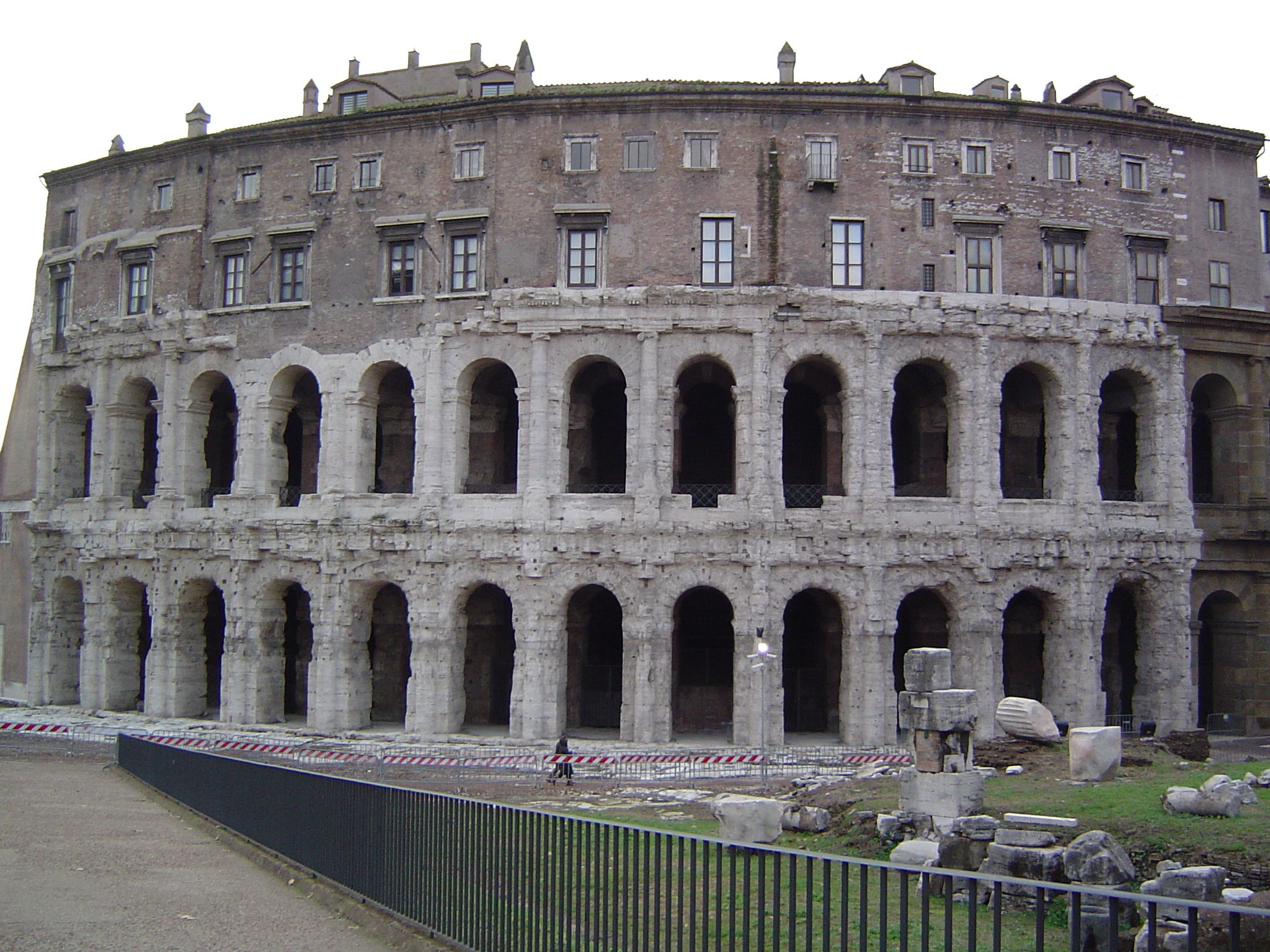
The Public Broadcasting Company (PBS), creator of the popular series “History Detectives” has sponsored its four investigators on a month-long archeological/architectural and cultural history workshop in Rome. PBS is considering expanding its scope from investigating the provenance of American artifacts to analyzing and investigating objects from other cultures. The investigators’ areas of expertise range from architecture and construction, engineering, to history and the arts. The Rome Conference will provide the group with much needed background to enable them to apply their investigative skills to researching artifacts and reconstructing historical evidence in other cultures.
While the group was completing its studies in Rome, they learn that sanitation crews spazzini have unearthed a puzzling find in the subterranean depths under the Via Del Teatro Di Marcello. This find was so unusual that the news was splattered across the front page of Corriere della Sera. Ancient artifacts are frequently found during the most common excavations in and around Rome. Even the most learned Italian archeologists, however, could not explain the significance or the provenance of the strange box or its contents. Inside the stone sarcophagus was an unusual combination of artifacts—so unusual that no local experts could agree on any aspect of the find. For when the lid was pried from the top of the sarcophagus, they found the following: a large brass bowl-like object, some shreds of disintegrating cloth, several chunks of different types of stone-like material, some post-Roman era coins, and a decaying Latin scroll ending with Vi...vi…s.
The History Detectives could not help but be drawn into the puzzling story. Did they not unravel similar, though much simpler, mysteries in the United States? Then they realized that this inexplicable discovery might prove to be the validation for expanding the scope of their investigations beyond the United States. If they could break the mystery—it they could not only identify the objects, but trace their provenance, perhaps they could also sell PBS on the idea of a much-expanded television program.
But…What were these objects? Why were they buried as they were? Would they be able to trace where they came from? And finally…What would they have to do to convince PBS to produce a new version of their program?

We decided that a sample show would be the best way to sell the idea to create a mock show to present to the board at PBS. We originally thought about recording it, but after weighing the time amount of time till the presentation was due and the time it would take to edit the video to our standards we decided that a live show would be a better option. After doing the presentation, we decided to cover the part about why PBS should use our show by planting a few questions with our groups adviser. This allowed a little more interactivity with the audience than simply showing the video.
All in all, this was a fun project to work on.
Here is a copy of the script used by our group.


2 comments:
Only two PBL per team..
Good Job David.. Interesting problem and your team did a good job researching it.
Post a Comment